# Releases: draft, preview, publish, roll back
Change the search configuration in a draft, see it as shoppers will, publish it the way the change needs and go back to an earlier release.
A [release](/docs/reference/glossary#release) is the shop's whole search configuration as files, one JSON file per area, kept as a version that never changes. Every search answer names the release and the [snapshot](/docs/reference/glossary#snapshot) it came from, and `GET /api/v1/live` names the same pair:
```sh title="Terminal"
live=$(curl -s -H "Authorization: Bearer $key" $api/live)
curl -s 'http://127.0.0.1:7800/v1/search?query=sofa' \
| jq -c --argjson live "$live" '{release: (.release == $live.release_id), snapshot: (.snapshot == $live.snapshot_id)}'
```
```json title="Answer: 200 · 5.3 ms · release b25a6aaa"
{"release":true,"snapshot":true}
```
A release is named by its content, so the same files always make the same release, whatever their whitespace or key order. The commands use `$key` and `$api` from the [Quickstart](/docs/quickstart#keep-the-management-key-at-hand).
**Reference:** [`GET /api/v1/live`](/docs/reference/management-api#live) · [`StoredRelease`](/docs/reference/management-api#StoredRelease)
## The release files
A release holds up to fourteen files, each optional:
- [`types.json`](/docs/reference/release-files/types) and [`attributes.json`](/docs/reference/release-files/attributes): what is searched and what each value means ([Types and attributes](/docs/types-and-attributes))
- [`channels.json`](/docs/reference/release-files/channels): the markets with their languages and currency ([Channels](/docs/channels))
- [`categories.json`](/docs/reference/release-files/categories): each page's facets and sorting ([Pages](/docs/pages))
- [`synonyms.json`](/docs/reference/release-files/synonyms): words that find each other ([Synonyms](/docs/synonyms))
- [`patterns.json`](/docs/reference/release-files/patterns): phrases that become filters, such as "3-sitzer" (three-seater) ([Patterns](/docs/patterns))
- [`rules.json`](/docs/reference/release-files/rules): pins, boosts, buries, hides and redirects ([Rules](/docs/rules))
- [`ranking.json`](/docs/reference/release-files/ranking): signals, weights and sort orders ([Ranking](/docs/ranking))
- [`overlays.json`](/docs/reference/release-files/overlays): corrections and badges for catalog data ([Overlays](/docs/overlays))
- [`routes.json`](/docs/reference/release-files/routes) and [`redirects.json`](/docs/reference/release-files/redirects): the shop's URLs and the old shop's ([URLs and redirects](/docs/urls))
- [`feed.json`](/docs/reference/catalog/feed): how the export's columns are read ([Importing and mapping](/docs/importing))
- [`tests.json`](/docs/reference/release-files/tests): search tests ([below](#search-tests))
- [`relations.json`](/docs/reference/release-files/relations): what a link between entities means, such as a product's `brand`; checked, read by no search
**In the panel:**
**Settings → Advanced** lists the live release's files under **Release files**, each opening read only. **Download release** saves them as one zipped folder, the files a team keeps in Git.
**Through the API:**
Store a folder of files as a release, each file keyed by its name. This stores the home store's:
```sh title="Terminal"
jq -n '{files: [inputs | {(input_filename | split("/") | last): .}] | add}' tests/fixtures/home/*.json \
| curl -s -H "Authorization: Bearer $key" -H 'Content-Type: application/json' -d @- $api/releases | jq -r .id
```
Storing changes nothing shoppers see. It answers `201` with a new release, or `200` when the same files were stored before.
**Reference:** [`POST /api/v1/releases`](/docs/reference/management-api#create-release) · [`GET /api/v1/releases/{release}`](/docs/reference/management-api#show-release)
## Change in a draft
Changes go into a [draft](/docs/reference/glossary#draft) first, so shoppers see nothing until you [publish](/docs/reference/glossary#publish) it. A draft is an [import](/docs/reference/glossary#import): the live catalog, or a new export, with the files it changes.
**In the panel:**
**Synonyms**, **Fields & typos**, **Pages**, **Banners** and **Rules** all write the one working draft. Your first change starts it; on Pages and Rules, **Start a draft** first. The badge beside the title then reads **Draft**, and **Discard** throws the draft away.
**Through the API:**
Start an import with the catalog, then change its files. This sorts the sofa page `wohnen/sofas` (wohnen: living) by price, lowest first:
```sh title="Terminal"
draft=$(curl -s -X POST -H "Authorization: Bearer $key" -H 'Content-Type: application/x-ndjson' \
--data-binary @tests/fixtures/home/catalog.jsonl "$api/imports?name=catalog.jsonl" | jq -r .import.id)
version=$(curl -s -H "Authorization: Bearer $key" $api/imports/$draft | jq -r .version)
version=$(jq --arg version "$version" '{version: $version, files: {"categories.json":
((.nodes[] | select(.category == "wohnen/sofas")).sort = {default: "price_asc"})}}' \
tests/fixtures/home/categories.json \
| curl -s -X PATCH -H "Authorization: Bearer $key" -H 'Content-Type: application/json' -d @- $api/imports/$draft \
| jq -r .version)
```
A file you send replaces the published release's file whole, and the draft reads the others from it. Each write names the `version` you read, and a draft changed since refuses it with `409`.
The [panel](/docs/reference/glossary#panel) writes the newest draft, so a merchant in the panel and an agent on the API work on the same one.
**Reference:** [`POST /api/v1/imports`](/docs/reference/management-api#create-import) · [`PATCH /api/v1/imports/{import}`](/docs/reference/management-api#change-import)
## Preview
A preview, in the [Playground](/docs/reference/glossary#playground) or through the API, answers as shoppers will be answered, with the [trace](/docs/reference/glossary#trace) that says why.
**In the panel:**
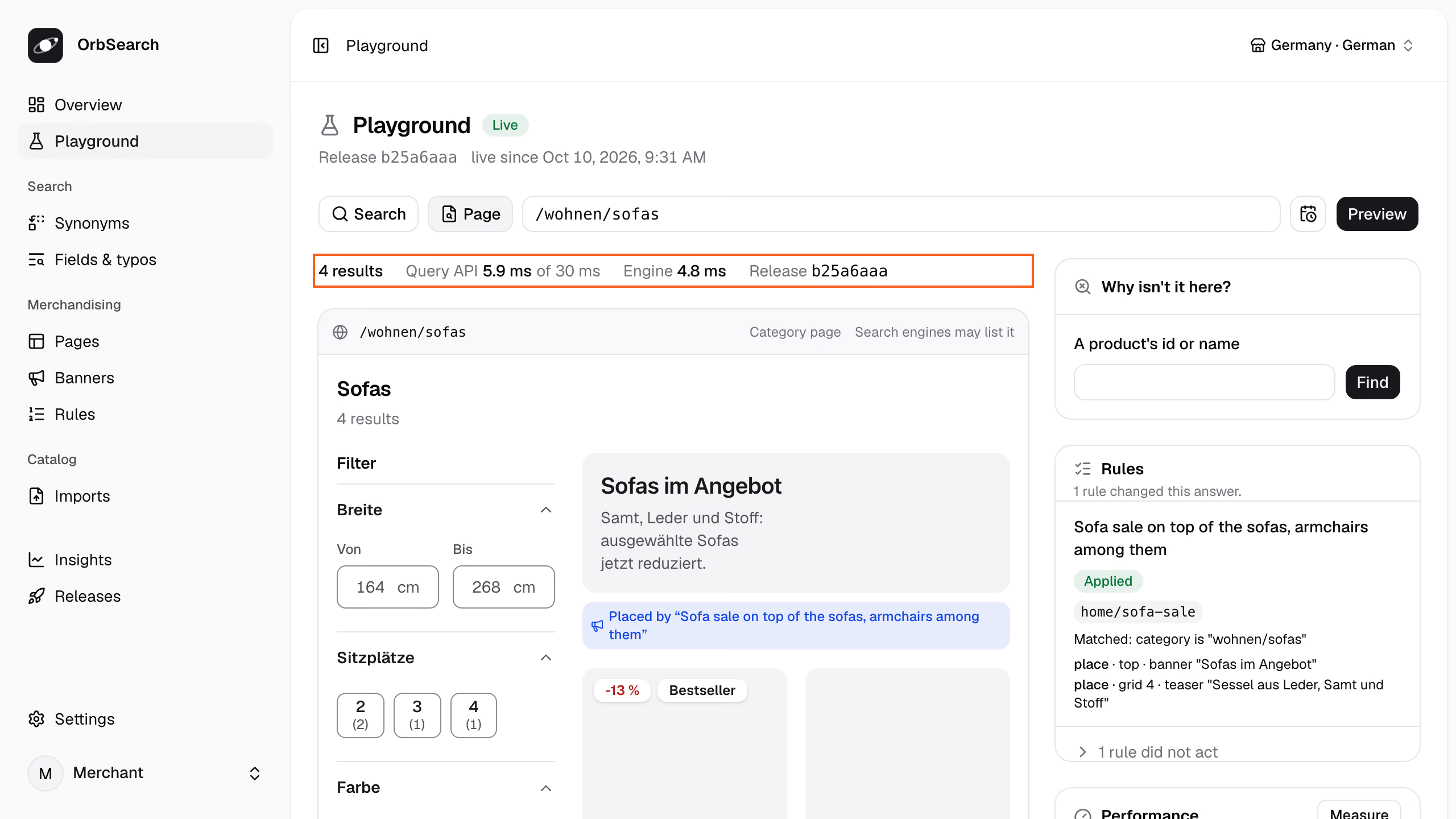
Panel · Playground
The **Playground** shows any search or page of the shop. Type what a shopper types, or a URL of the shop, and press **Preview**:
- The strip above the page says what it is: its kind, where a redirect leads, whether search engines may list it.
- The line above it holds the answer's numbers: the results, the Query API's time against its budget, the engine's share and the release.
- **Performance** keeps them copyable for a bug report, and **Measure** sends the preview 20 times for its p50, p95 and slowest round trip.
The channel and language in the top bar, shared with Pages and Rules, decide what it answers in, and a playground link carries them. On **Pages**, **Preview this page** shows the draft's page and opens it in the Playground.
**Through the API:**
`POST /api/v1/preview/page` opens a URL of the shop as a shopper would, with a draft's files in place of the live release's:
```sh title="Terminal"
curl -s -H "Authorization: Bearer $key" $api/imports/$draft | jq '{url: "/wohnen/sofas", files}' \
| curl -s -H "Authorization: Bearer $key" -H 'Content-Type: application/json' -d @- $api/preview/page \
| jq -r '.results | (.trace.steps[] | select(.step == "sort") | .reason),
(.sections[] | select(.type == "product") | .hits[] | "\(.entity) \(.fields.sale_price // .fields.price)")'
```
```text title="Answer: 200 · 31 ms · release 6950b4be"
The category wohnen/sofas sets price_asc as the default sort of its page and the pages below it.
product:SOFA-ASKA-2 649.0
product:SOFA-NIKO-SCHLAF 799.0
product:SOFA-LUND-3 1299.0
product:SOFA-VIDAR-ECK 1899.0
```
The sofas come lowest price first, as the trace's sort step says. `POST /api/v1/preview/search` answers a search against what is live, and both may fix `time` to see a scheduled rule on its day.
A preview reads the live indexes. What a draft changes in them, such as a rule's pins or a new attribute, shows once
it is published.
**Reference:** [`POST /api/v1/preview/page`](/docs/reference/management-api#preview-page) · [`POST /api/v1/preview/search`](/docs/reference/management-api#preview-search)
## How a publish goes live
Publishing makes a release the active configuration, and an [index run](/docs/reference/glossary#index-run) takes it live, doing only what the change needs. You see how before anything goes live.
**In the panel:**
Synonyms, Fields & typos and Banners publish from a bar that says how the draft goes live, such as "Goes live at once." On Pages and Rules, **Review and publish** compares the draft with what is live and says the same before **Go live**.
**Through the API:**
Ask how the draft would go live:
```sh title="Terminal"
curl -s -H "Authorization: Bearer $key" $api/imports/$draft/publication | jq -r .course.sentence
```
```text title="Answer: 200 · 27 ms"
Goes live at once: only categories.json changed what the Query API reads.
```
Publish it with the version you reviewed, so a draft changed since is refused:
```sh title="Terminal"
curl -s -X POST -H "Authorization: Bearer $key" "$api/imports/$draft/publish?version=$version" | jq -r .next
```
A release stored whole publishes with `POST $api/releases//publish`. Searches read it once the run succeeds, and keep what was live if it fails. A draft you do not publish is discarded:
```sh title="Terminal"
curl -s -X DELETE -H "Authorization: Bearer $key" $api/imports/$draft | jq -r .state
```
```text title="Answer: 200 · 17 ms"
discarded
```
A publish takes one of three ways:
- **Switch:** only what the Query API reads changed, such as rules, the layout of pages, patterns, routes or redirects. It goes live at once; a pin took about 0.2 s on the demo's 5,215 products.
- **Settings:** only the synonyms, the order of a type's searched fields or how many typos its words forgive. The engine applies them to the live indexes within moments, without reindexing.
- **Rebuild:** what the documents are built from changed, such as the fields a type searches, channels, attributes, overlays, the feed mapping, ranking signals, the facets pages count, or the catalog. New indexes are built beside the live ones while the shop keeps answering.
A rebuild also runs after an update of OrbSearch, when the engine lost its indexes, and when a sale window or an [overlay](/docs/overlays) ends. The answer's `course.because` names the cause and, for a rebuild, `estimate_seconds` its time. Every trace names how the live run went live as `trace.live`.
**Reference:** [`Course`](/docs/reference/management-api#Course) · [`GET .../publication`](/docs/reference/management-api#show-import-publication) · [`POST .../publish`](/docs/reference/management-api#publish-import) · [`DELETE /api/v1/imports/{import}`](/docs/reference/management-api#discard-import)
## Roll back
A [rollback](/docs/reference/glossary#rollback) publishes an earlier release again. It goes live with the current catalog, by the same three ways, and the release the live one replaced is marked previous.
**In the panel:**
**Releases** lists the releases, the last published first, each marked **Live**, **Going live**, **Previous** or **Was live**. A row's menu offers **Publish this release** or **Roll back to this release**, in a dialog that says how it would go live. **Index runs** below says how each run went live, with its **Report**.
**Through the API:**
```sh title="Terminal"
previous=$(curl -s -H "Authorization: Bearer $key" $api/releases | jq -r '.data[] | select(.role == "previous") | .id')
curl -s -H "Authorization: Bearer $key" $api/releases/$previous/publication | jq -r .course.sentence
curl -s -X POST -H "Authorization: Bearer $key" $api/releases/$previous/publish | jq -r .next
```
Each listed release carries its `role` and the `course` it last went live by.
To go back to an earlier catalog together with its release, publish the import it came with again ([Importing and mapping](/docs/importing)).
**Reference:** [`GET /api/v1/releases`](/docs/reference/management-api#list-releases) · [`POST /api/v1/releases/{release}/publish`](/docs/reference/management-api#publish-release)
## Validation
Every write is checked whole before it is kept. A violation answers `422` with the file, a JSON pointer and what is wrong. Here a search test asks for a channel the store lacks:
```sh title="Terminal"
jq -n '{files: [inputs | {(input_filename | split("/") | last): .}] | add}
| .files["tests.json"].tests[0].request.channel = "at"' tests/fixtures/home/*.json \
| curl -s -H "Authorization: Bearer $key" -H 'Content-Type: application/json' -d @- $api/releases \
| jq -r '.violations[] | "\(.file) \(.pointer): \(.message)"'
```
```text title="Answer: 422 · 23 ms"
tests.json /tests/0/request/channel: "at" is not a channel in channels.json; the channels are de.
```
Each file must match its schema, unknown fields included, and every reference between files must hold. Category and product ids belong to the catalog and are not checked. An index run checks again with the files it derived; if they do not fit, it fails and what was live stays.
**Reference:** [`422`](/docs/reference/problems#422)
## Search tests
A search test is a request, exactly as the Query API receives it, and what must stay true about its answer. "3-sitzer grau" (three-seater grey) must resolve to both filters:
```json title="tests/fixtures/home/tests.json (trimmed)"
{
"tests": [
{
"id": "three-seater-in-grey",
"request": { "query": "3-sitzer grau" },
"expect": { "resolved": { "filters": { "color": "grey", "seats": 3 } } }
}
]
}
```
A test can expect the `redirect`, what the query `resolved` to, the `rules` applied, the order of `sections`, and its `results`, such as the `first` hit. A trace's `request` can be copied into a test as it is.
OrbSearch checks search tests when a release is stored, but never runs them. A test whose answer changed does not
stop a publish.
Storing refuses a test that expects nothing, a request the Query API would refuse, and a rule, type or field that does not exist.
**Reference:** [`tests.json`](/docs/reference/release-files/tests) · [`expect`](/docs/reference/release-files/tests#expect)
## Defaults and zero configuration
A release need not write every file: every index run derives the ones it leaves out from the catalog, so they follow it. A search with `debug=1` names them:
```sh title="Terminal"
curl -s 'http://127.0.0.1:7800/v1/search?query=sofa&debug=1' | jq -c '.trace.derived'
```
```json title="Answer: 200 · 5.1 ms · release b25a6aaa"
["types.json"]
```
The home store writes `types.json` but leaves out which attributes are exempt from typos, so that part is derived. A written file wins whole, except `categories.json`, which derives the parts it leaves out. [Your own catalog](/docs/your-own-catalog) goes live with no files at all, and [the import report](/docs/import-report) gives each [derived setting](/docs/reference/glossary#derived-setting) its reason.
## JSON Schemas
Each release file has a JSON Schema, generated from the contract at `contracts/schema/.json`. Name it in the file's `$schema` key, and an editor checks and completes the file as you type:
```json title="tests/fixtures/home/synonyms.json (trimmed)"
{
"$schema": "../../../contracts/schema/synonyms.json",
"synonyms": { "de": { "groups": [["sofa", "couch"]] } }
}
```
The Query API keeps `$schema` as written.
## Next
- [Rules](/docs/rules): pin, boost, bury, hide and redirect, the changes a draft carries most.
- [Pages and their filters](/docs/pages): each page's facets and sorting, previewed before they go live.
- [The import report](/docs/import-report): what a run read, left out and derived.